
Limited palettes, tiny mushrooms, and remembering how much I love to paint
There are paintings you plan very carefully, and then there are paintings that begin with, “I want to paint something cozy today.”
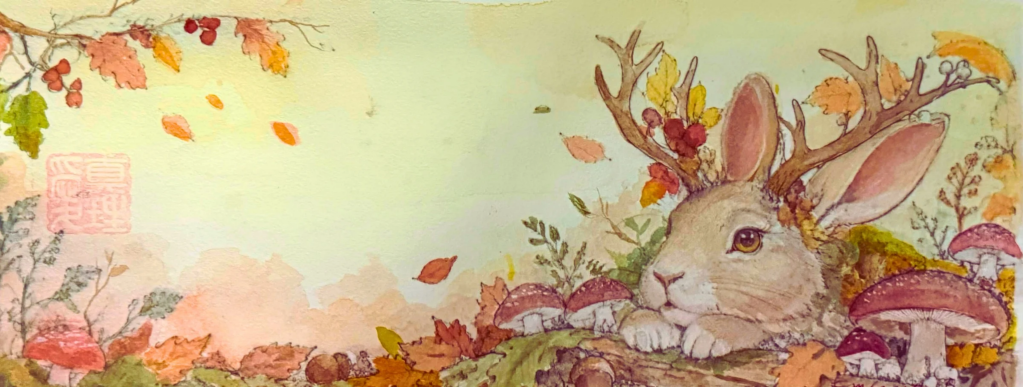
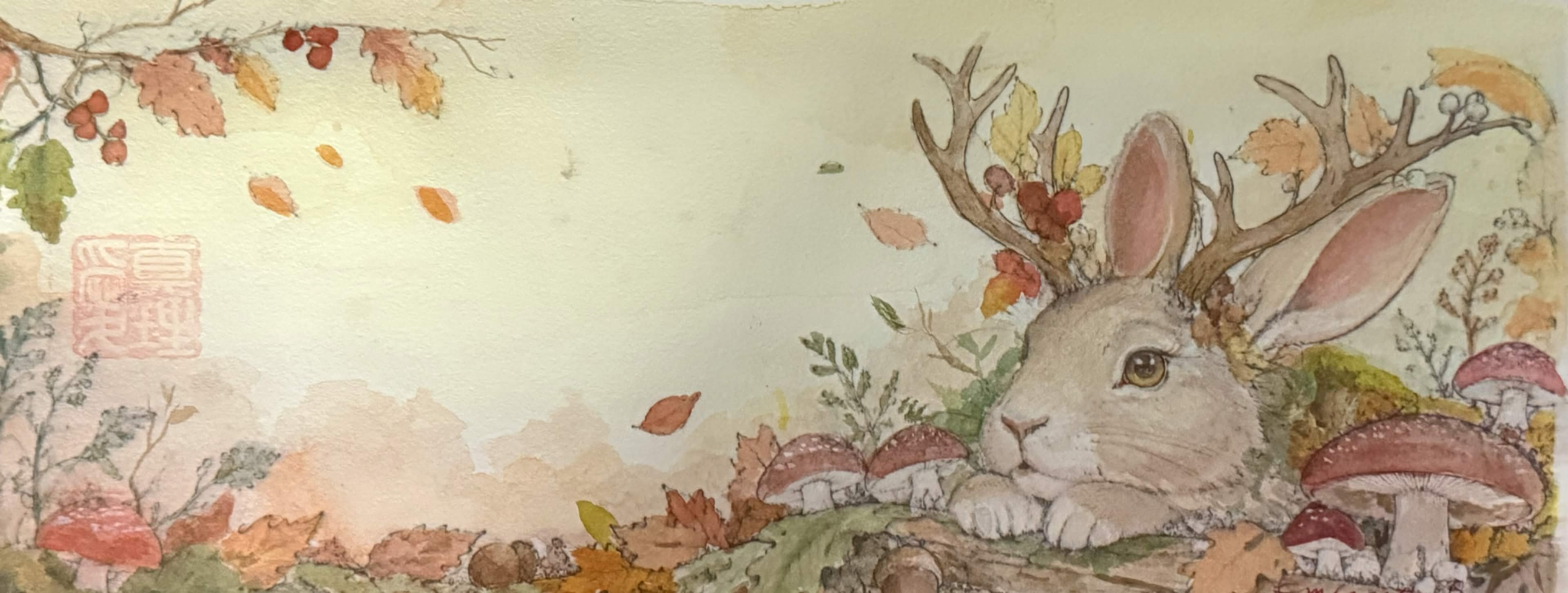
This little autumn jackalope was definitely the second kind.
I wanted something that felt like a page from an old storybook—a quiet woodland creature tucked between mushrooms, fallen leaves, moss, and all the lovely rusty colors that appear when the year starts settling down.
And, perhaps more importantly, I wanted to finish a painting.
Lately I’ve been trying to make my way back into creating regularly. Not for a client, not because something needs to be designed, and not because it belongs on a task list. Just because I wanted to sit down with paper, paint, and a brush and see what happened.
This happened.
The Materials
For this piece, I painted with Holbein Artists’ Watercolors on watercolor paper.
I’ve been enjoying Holbein because the paints are beautifully pigmented without becoming difficult to control. They can give you strong, rich color when you need it, but they also dilute into the kind of soft transparent washes I love for whimsical illustration.
Instead of pulling out half the paint box, I deliberately worked with a limited palette.
The palette stayed mostly within:
- warm earthy browns
- ochres and golden yellows
- rusty oranges
- muted reds
- soft greens
- gentle pinks and neutrals
Nothing terribly complicated.
The goal was to let the colors mix with one another rather than constantly reaching for a new tube.
That helped keep the whole painting feeling related—even though there are antlers, mushrooms, leaves, berries, fur, moss, and approximately seventeen thousand tiny woodland things happening in it. 😆
Why a Limited Palette?
One of the things I keep relearning about watercolor is that more colors don’t necessarily make a painting more interesting.
Sometimes they just make it more chaotic.
A limited palette forces me to mix.
The brown in the fur can show up again in the antlers. The rusty red from the leaves can become the mushroom caps. A softened green can move from the moss into the foliage.
Suddenly all the different pieces belong to the same little world.
It also creates those accidental colors that are nearly impossible to get straight from a pan or tube—the slightly muddy olive, the warm grey, the dusty rose-brown.
Those imperfect colors are usually my favorites.
Building the Painting
I started lightly, keeping the first washes soft and transparent.
The background is intentionally quiet because I wanted the jackalope to remain the obvious focal point. Rather than painting a detailed forest behind her, I used pale washes and small botanical marks to suggest the environment.
Then came the more detailed parts.
The face.
The ears.
The eye, which, naturally, received an unreasonable amount of attention.
And then the mushrooms.
Because apparently I am physically incapable of painting an enchanted woodland scene without putting mushrooms in it.
Fair enough.
The darker values were added gradually around the eye, beneath the chin, inside the ears, under the paws, and around the mushrooms. Those small shadows are what finally began giving the rabbit some shape and weight.
The surrounding leaves and foliage were much looser.
I didn’t want every leaf perfectly rendered. Some are defined, others are little more than marks and washes. That variation helps keep the painting from becoming too stiff.
Watercolor Is Still Teaching Me to Leave Things Alone
Possibly the hardest watercolor technique:
Stop touching it.
There is always that dangerous moment when a painting looks nearly finished and your brain whispers,
Maybe just one more layer.
This is frequently a trap.
Watercolor needs white paper. It needs breathing room. It needs places where pigment fades instead of being carefully corrected into submission.
I’m still learning when a painting is asking for another layer—and when it is quietly begging me to put the brush down.
With this piece, I tried to keep some of that softness.
Not every edge is perfectly crisp.
Not every shape is filled.
There are blooms, textures, little changes in pigment and places where the watercolor simply behaved like watercolor.
And I like it better that way.
The Finished Jackalope
What I love most about her isn’t really the technical part.
It’s the mood.
She looks as though she’s been sitting there long before we arrived.
Maybe guarding the mushrooms.
Maybe collecting acorns.
Maybe she knows precisely where the path into the fae woods begins and has simply decided not to tell us.
Which is honestly very jackalope behavior.
More than anything, though, finishing this painting reminded me that creating doesn’t always need to become something useful.
Sometimes a painting can exist because you wanted autumn colors.
Because you wanted to paint antlers.
Because mushrooms are fun.
Because you’ve been away from your brushes for a while and wanted to see whether your hands still remembered what to do.
Mine did.
A little rusty, perhaps.
But still here. 🍂
Materials: Holbein Artists’ Watercolors • watercolor paper • limited autumn palette
Medium: Watercolor
From the Studio: Marikit Studios
Think. Dream. Create. Believe.


Leave a comment